 SlayTrolls
What a Coordinated Troll Attack Actually Looks Like (And How Fast It Spreads)
You've seen it happen. A politician posts a statement. An activist shares their stance. A public figure says something controversial — or sometimes, nothing controversial at all.
Then, within hours, the comment section turns into a warzone. Hundreds of laughing emojis. Copy-paste insults. Screenshots circulating in group chats. And suddenly, a reputation that took years to build is drowning in a coordinated attack they never saw coming.
It looks random. It feels personal. But most of the time? It's coordinated — and the goal isn't just to hurt you, it's to hijack what people think you said.
First, Understand the Battlefield
Facebook isn't just a social network — for billions of people, it's where they get news, run businesses, build communities, and spend hours of their day.
With over 3 billion monthly active users, it's one of the most powerful amplification machines ever built. That same reach that helps you grow an audience also means coordinated attacks can find you fast.
A 2019 study by the Oxford Internet Institute identified organized social media manipulation campaigns across 70 countries — consistently blending automated accounts with real, willing participants recruited to pile on.1 This isn't fringe behavior. It's documented, global, and growing.
The Anatomy of an Attack: A Realistic Timeline
Hour 0: The Trigger
Someone — a political opponent, a rival, a random person with a grudge — screenshots one of your posts. That screenshot gets shared in a private group or group chat with a caption designed to provoke: "Look at this. What do you think?" The match is lit.
Private Facebook groups can have hundreds of thousands of members. The screenshot is now in front of an audience primed to react.
Hour 1–2: The Reaction Wave
Before the comment flood arrives, you'll often notice a spike in 😂 reactions on the targeted post — reacting is faster than commenting, so people see the callout, click through to your actual post, and hit the laugh react before they even read your caption. Research analyzing millions of Facebook 'haha' reactions has found the reaction is widely used to mock rather than express genuine amusement.2
Your normal reaction count can multiply 10x or more in under an hour.
Hour 2–4: The Comment Flood
Now the comments arrive. And they come in patterns that reveal coordination:
- Copy-paste phrases. The same sentence — sometimes word for word — posted by multiple accounts.
- Tag trains. Users tagging friends to "come see this," pulling in second- and third-degree connections with zero context.
- Character attacks. Dredging up old posts, out-of-context quotes, or outright fabrications to paint a narrative.
These patterns aren't random. You're not just fighting bots. You're fighting real people who were actively recruited to pile on — and they came prepared.
Hour 4–24: The Damage Hardens
By now, the pile-on has momentum. New visitors to your page see a comment section full of ridicule and react accordingly — social proof works in reverse, too.
Your legitimate followers go quiet — real research backs this up: 27% of U.S. adults say they've refrained from posting online after witnessing harassment of others.3
Why Manual Moderation Can't Keep Up
The math is brutal. On one of our own client pages, a single coordinated attack peaked at 224 comments in one hour — arriving faster than any human moderator could realistically triage, even working non-stop.
Factor in sleep, actual work, and the mental toll of reading hundreds of personal attacks — there's no realistic way to stay on top of it manually. By the time you see the first wave, the damage is already done.
And deleting the post doesn't help either. Screenshots already exist. Now the narrative becomes: "They deleted it. Guilty."
So What Can You Actually Do?
The best defense against coordinated troll attacks is speed — specifically, the ability to hide toxic comments faster than they can pile up and start defining the story.
Not delete. Not block. Hide. Because hidden comments are invisible to everyone except the person who posted them. The troll thinks their comment is still up. Blocking, by contrast, is visible — the troll gets a signal, screenshots it, and posts it as proof they've been "censored," recruiting more people to pile on. Hiding gives them nothing to screenshot. The fire doesn't get oxygen.
Your trolls are organized. Now your page has a team that is too — one that studies the pattern instead of reacting to each comment.
This is what SlayTrolls does. It's a simple Facebook comment moderation tool that monitors your page's comments, identifies troll patterns in real time, and silently hides them — the troll never knows. Just quiet, automatic protection that works while you sleep. Because the goal isn't to win an argument with a troll. It's to deny them the audience they came for.
References
- [1]Bradshaw, S. & Howard, P.N. (2019). The Global Disinformation Order: 2019 Global Inventory of Organised Social Media Manipulation. Oxford Internet Institute.
- [2]Phillips, J.B. (2024). Laughing at death: Facebook, the 'haha' reaction, and death coverage on local US news pages. Popular Communication, 22(1), 17–32.
- [3]Duggan, M. (2017). Americans on Witnessing Online Harassment. Pew Research Center.
About the author

Elmer is the founder of SlayTrolls. He is a solo developer, entrepreneur and advocate for safer online spaces. Outside of work he loves freediving and goofing around with his wife and two kids.
LinkedIn →Related posts
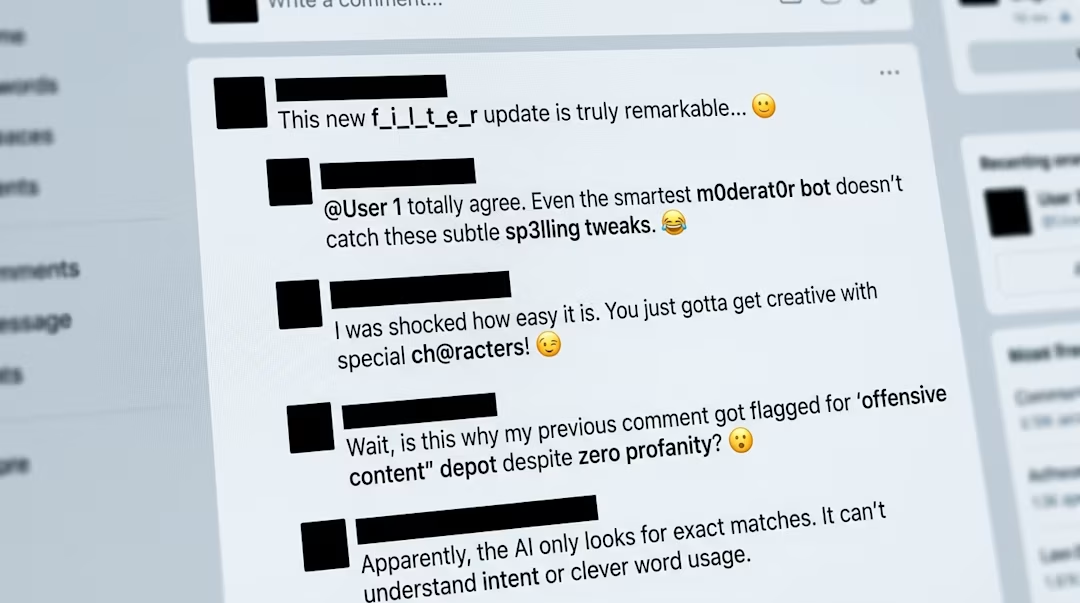
Why Keyword Filters Fail Against Trolls (And What Actually Works)
Trolls have turned filter evasion into an art form — character substitution, coded sarcasm, emoji attacks, and slang that no blocklist will ever catch. Here's why your keyword list will never be enough.

Elmer Cruz
Last updated: March 22, 2026

What Troll Comments Actually Cost You (Beyond the Insult)
Troll comments do more damage than it looks. Here's what actually happens to your real supporters and your reputation — long after the comments are gone.
Elmer Cruz
Last updated: March 23, 2026